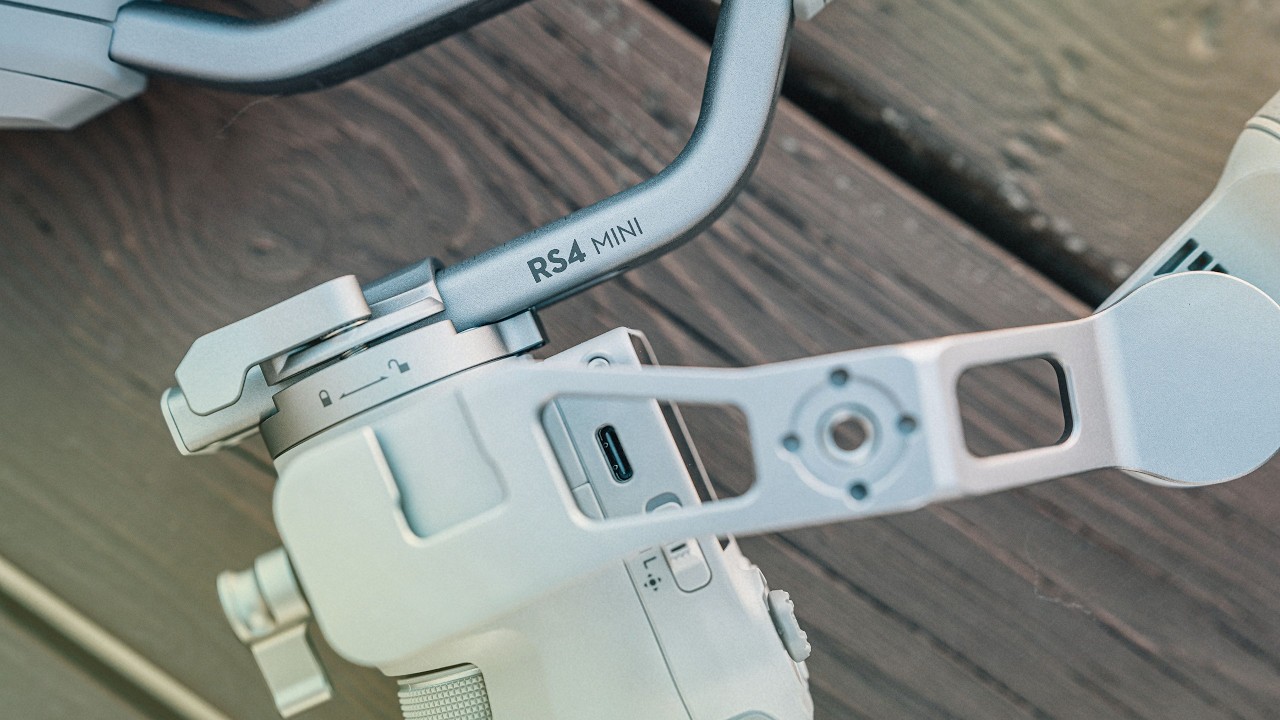
After a year and a half of real work, the RS4 Mini is the gimbal I actually bring. Small enough to never leave behind, with ActiveTrack good enough to replace a camera operator.
Check Price at B&H →Highlights
- Small and light enough to fit in a regular camera bag with no extra case
- ActiveTrack with hand gestures replaces a camera operator for solo shooting
- Lasts a full working day on a single charge, recharges over USB-C
- Handles a Sony A7V or A1 II without the grip with a small to medium lens
- Record trigger and ActiveTrack gestures work together for hands-free starts and stops
- Less distracting than a full-size gimbal on client locations
Drawbacks
- No removable battery, so you can't swap in a fresh one mid-day
- Not built for heavy bodies with large lenses
- Very sensitive to calibration and won't always warn you when it's off
Probably one of the best gear decisions I made in the past couple of years was picking up a smaller gimbal. I had the DJI RS4 Pro, and I found myself not using it very often because it was too big and bulky for the type of shooting I was doing. So I went with the RS4 Mini. I bought it right when it came out in February of 2025 because I wanted the auto tracking and I wanted something smaller, since I’m usually running it with a smaller camera.
That was about a year and a half ago. I’ve been using it on real jobs ever since, and I sold the RS4 Pro four or five months ago because it was just sitting there. This is a long-term review. Here’s what I’ve learned.
When I Actually Use a Gimbal
When I grab a gimbal, I’m usually shooting on location. Maybe a commercial building, maybe inside a business, and I need to get a lot of different shots. Occasionally I still shoot a wedding, and if I’m shooting video there, I’m definitely on a gimbal. The common thread is that I’m moving around quickly, I don’t have room to set up a tripod, and I’m probably not going for that look anyway.
For that kind of work, I want the gimbal to be small, easy to grab, and easy to manage. I don’t want a bunch of bulk to carry around, because I’m also shooting with other cameras and doing other things at the same time. The RS4 Mini fits that. It handles smaller cameras really well, and even when the camera gets a little bigger, like my A7V or my A1 II without the battery grip, it’s more than strong enough. If I were to put a larger lens on the A1 II, that starts getting heavy and probably too much for it, but that’s not how I’m using a gimbal.
Filming Myself With ActiveTrack
This is where the RS4 Mini really earns its spot in my kit. I typically don’t have anybody assisting me when I film my videos. When I need to be out and moving while I’m recording, I just trigger ActiveTrack and let it follow me around.
It has a small tripod base so I can set it on a table, but with the 1/4-20 on the bottom I can also mount it on a full-size tripod and get it up off the ground. At that point it’s almost like having a camera operator behind the tripod. I point the camera at myself, hold up my hand, the light on the front turns green, and now the camera follows me as I move around. When I’m done, I put my hand up again, the light turns red, and I know it’s no longer tracking. A double tap on the trigger sends it back to center.
I no longer have to talk somebody into going out and holding a camera for me. I have a tool that does it. I’ve also used it at conferences where a speaker is moving around the stage a lot. I set it on a tripod with a lens pointed at them, and it follows them while I’m free to get other shots, pay attention to other cameras on tripods, or grab handheld footage that looks a little more natural.
If you shoot a lot of walk-and-talks, this is a great setup. Teach your subject the hand gesture, and once the light goes green all you have to focus on is keeping your distance consistent.
My Quick Release Setup
I run a Falcam quick release system on the RS4 Mini, and I’d call it almost a must if you’re taking the camera on and off the gimbal often. The way I have it set up, I can slide the camera out and go handheld, or use the camera for something else, and the gimbal locks itself when I power it down. I fold it, set it aside, and it’s out of the way.
When I need to go back to the gimbal, I grab the camera, slide it into the mount, make sure it’s locked, power the gimbal on, and it unlocks and goes right into position. It’s one of the things I love most about this setup. It’s just quick.
Most of the time I keep a small camera body on the gimbal so it’s always ready to go, and I use my other cameras for everything else.
Why Small Won Out Over the RS4 Pro
Something I’ve found with all the gear I’ve acquired over the years is that a piece of equipment has to solve more friction than it introduces. It’s easy to buy a new shiny thing, and then the setup takes too long, or it’s too big so you leave it behind half the time, and there’s always something that keeps it from being usable.
The RS4 Mini is small and compact enough that I just take it with me. Often I don’t even use the arm on the back. Once I power it down and pull the tripid foot off, it fits in my bag without taking up much space. With the RS4 Pro I was packing a whole separate bag because it’s so much larger and there were so many attachments I’d bring along and never use.
Yes, there’s the newer RS5 now. It’s a bit bigger, has the detachable battery, handles more payload, and costs more. There isn’t an RS5 Pro yet either. If I were running a heavier payload I’d probably want an RS5 Pro. But for the way I shoot, the Mini is the one that keeps going in the bag.
Battery and Charging
The RS4 Mini does not have a removable battery like some of the other RS models. In practice that hasn’t been a problem for me. It charges over USB-C on the side, I plug it in at night on a multi-day job, and it’s ready the next morning. It lasts me the whole day.
To be fair, I’m not keeping it powered on for 8 to 10 hours straight. I grab a few shots, power it off, it goes into lock mode, and I set it aside until I need it again. Used that way, I’ve never had it die on me.
Tips for Getting the Most Out of the RS4 Mini
Calibrate every single time
Run the horizontal calibration even if you’re reconnecting the same camera in the same position. This gimbal is very sensitive to calibration. You can do it from the menu on the back or from the app under Status, then Horizontal Calibration. Hold the base down on the table so it doesn’t vibrate while it runs.
I do this just about every time I take the camera off and put it back on. Sometimes the gimbal tells you calibration is off, and sometimes it doesn’t. If it’s off and you don’t know, it’s not going to stabilize your footage the way it should.
Dial in the speed settings
There are a lot of adjustments for how fast or slow the gimbal moves. For action you want it responding quickly, so put it in fast mode. For slower, more methodical movement, use medium or slow. I keep the joystick on the slow side, because if I’m using the joystick I’m usually after a smooth, deliberate move. If I want something more abrupt, I steer the camera physically instead.
Trigger recording from the gimbal
You can set it up so the record button on the back of the gimbal starts and stops recording on your camera. I have that set up on my A7V, which is the camera I use on this gimbal most. What’s even better is in ActiveTrack mode: hold up your hand to start tracking, then hold up a peace sign and it starts recording. The LED ring stays green while you’re tracking and flashes to confirm recording started. Same gestures stop it.
Who the RS4 Mini Is For
If you’re running a smaller mirrorless camera, or an A7IV or A7V style full frame body with a small to medium lens, the RS4 Mini will handle it without a problem. It’s great for solo content creators who need to film themselves, for walk-and-talks, for B-roll in tight spaces where a bigger rig won’t fit, and for anyone who wants a gimbal that doesn’t draw attention to itself.
If you’re putting big glass on a full-size body, look at the RS5 or wait for an RS5 Pro. This isn’t the gimbal for heavy payloads.
I know some DJI products are getting harder to find, but the RS4 Mini is still available at B&H and Amazon, and the pricing is good.
Closing Thoughts
When you find a tool that adds more value than it does friction, that’s when you end up sticking with it and still talking about it a year and a half later. Time and time again, this is the gimbal I end up choosing. The ActiveTrack works really well, and the size means I never think twice about bringing it.
Final Verdict
Was this helpful?
Frequently Asked Questions
Can the DJI RS4 Mini handle a full frame camera?
How long does the DJI RS4 Mini battery last?
Is the DJI RS4 Mini good for filming yourself?
Should I get the DJI RS4 Mini or the RS5?
Why does my RS4 Mini footage look shaky?
