
Hollyland Solidcom C1 Review: The Best Wireless Intercom for Multicam Video Production
The best wireless intercom system I've used for independent event video production. After a full year of real-world use, it has earned a permanent place in my kit.
Check Hollyland Solidcom C1-4S → $799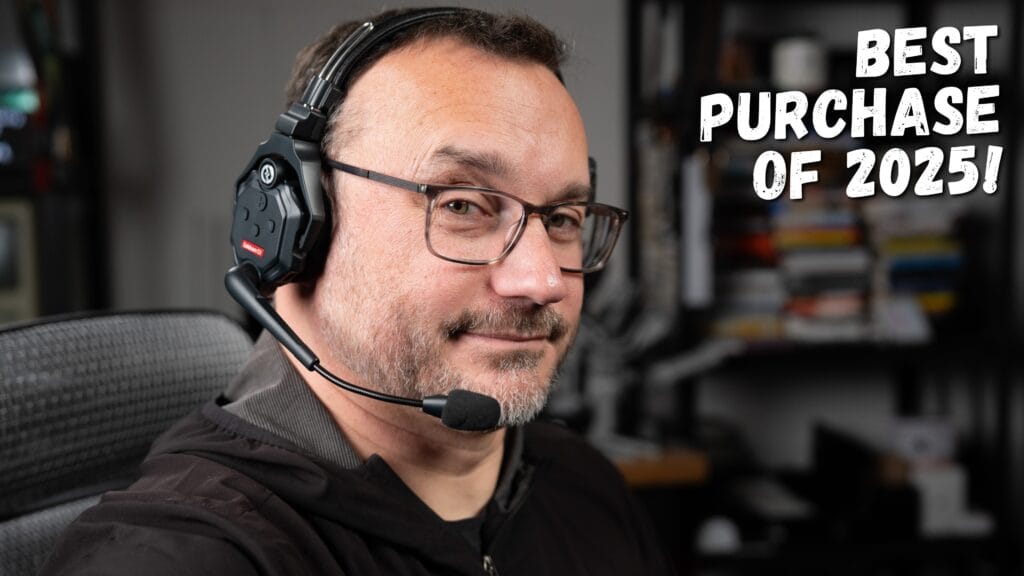
What We Like
- DECT 1.9 GHz technology eliminates interference in crowded venues packed with Wi-Fi and cell phone traffic
- Comfortable enough for 3+ hour continuous wear without fatigue or pressure points
- Battery life meets or exceeds the rated 8 hours — ran a full 3-day event on a single charge per headset
- Maintains clear communication through walls and outside buildings, not just line of sight
- Near-zero latency with audio quality comparable to a modern phone call
- Physical mic mute via boom arm position eliminates button fumbling during shoots
- Dual A/B channel support allows segmenting larger production teams
What Could Improve
- Master headset must remain powered on for the entire system to function — losing it takes down all communication
- Premium price point is a meaningful investment compared to consumer-grade alternatives
- Overkill for solo shooters or anyone not regularly running multi-camera productions
| I’ve been shooting multicam live events professionally for years — weddings, school performances, church services, corporate events. I’ve tested a lot of intercom systems in real production environments, not on a lab bench. What follows is my honest assessment after a full year of using the Hollyland Solidcom C1 on paid client shoots. |
Overview: Why Wireless Intercoms Matter for Multicam Shoots
If you’re running a multicam video production and your camera operators are more than shouting distance away, you have a communication problem. It doesn’t matter how well you briefed your team before the shoot — things change the moment the event starts. A speaker moves. A light shifts. An unexpected moment happens on one side of the room. Without a reliable two-way intercom system, you’re flying blind.
I’ve used various solutions over the years: earpiece radios, consumer walkie-talkies, even improvised phone call setups. They all had meaningful limitations — either the audio quality was poor, they struggled with interference in crowded rooms, the range was unreliable, or they were simply too uncomfortable to wear for three straight hours.
The Hollyland Solidcom C1 solved all of those problems for me. After using the system extensively throughout 2024 and into 2025 — including a three-day multi-session event — I’m confident calling it the best wireless intercom system for independent video producers and event videographers working in the $500–$1,500 range.
Hollyland Solidcom C1 Specifications
| Specification | Detail |
| System Type | Full-duplex wireless intercom |
| Frequency | 1.9 GHz DECT |
| Range | Up to 1,000 ft (300 m) line of sight |
| Battery Life | Up to 8 hours per charge |
| Charging | Dual battery per headset, external charger included |
| Headset Units | Available in 2, 4, 6, 8, and 12-unit sets |
| Channels | A and B dual-channel communication |
| Latency | Near-zero (real-time communication) |
| Weight | Approximately 190g per headset |
| Connectivity | Master/slave configuration, all units connect to master |
What’s in the Box
I purchased the four-unit set, which is the most common configuration for independent videographers running a main camera plus two or three additional operators. The kit includes:
- Four Solidcom C1 headsets (one designated master, three slaves)
- Individual carrying pouches for each headset
- Hard shell carry case for the entire kit
- Battery charger with charging slots for multiple batteries
- Eight rechargeable batteries (two per headset)
- Charging cable and power adapter
The packaging is thoughtful and production-ready. Every piece has a home in the case, which matters when you’re loading in and out of venues in a hurry. The included pouches keep individual headsets protected and organized.
One detail I want to highlight: the power adapter. I keep one adapter permanently in the case and a second one at my home charging station. This means I never have to remember to pack the charger — it’s always in the case, ready to go. That kind of operational simplicity is worth more than it sounds at 6 AM the morning of a shoot.
Build Quality and Comfort
This is where the Solidcom C1 separates itself from most intercom systems in its price range. These headsets are genuinely comfortable for extended wear.
The ear cushions use a soft foam padding that doesn’t compress down to nothing after an hour of wear. The headband is padded on the contact point at the top of the head. The over-ear cup rotates independently, which is a feature I didn’t realize I needed until I had it — it means you can slide the headset forward or back to find your ideal fit without it pulling awkwardly on your ear.
For videographers who wear glasses, this flexibility is particularly valuable. You can reposition the cup to avoid resting on your glasses arm without the headset shifting into an uncomfortable position.
| I’ve had camera operators who complained about headset discomfort on every previous system I’ve used. When I introduced the Solidcoms, the feedback was immediate and positive. Nobody complained about the headsets once. |
The build feels solid without being heavy. These aren’t flimsy consumer headphones — the materials and construction communicate that they’re professional tools. At the same time, they’re light enough that you forget you’re wearing them after a few minutes, which is exactly what you want in a production headset.
Battery Life: Real-World Testing
On paper, the Solidcom C1 is rated for up to 8 hours of use per charge. In my real-world testing, that claim held up — and then some.
During a three-day event where each shooting day ran approximately two and a half to three hours, I deliberately tested whether we could run the same battery across all three days without swapping. At the end of the third shooting session, with roughly 7.5 to 9 hours of cumulative use on a single battery, the headsets were still operational with no low-battery warnings.
This is meaningful for event videographers. Battery anxiety during a live shoot is a real problem — the last thing you want is a headset dying in the middle of a ceremony or performance. The Solidcom C1’s battery longevity effectively eliminates that concern for most single-day and multi-day events.
My standard pre-event workflow: charge all batteries the night before the event, then plug the charger into my control station when I arrive on location. Batteries go into headsets when operators arrive, everyone keeps a spare battery on their person, and spares go back into the charger immediately after the event. In practice, I’ve never needed those spare batteries mid-shoot.
Signal Performance and Range
The Solidcom C1 uses DECT technology at 1.9 GHz, which is the same frequency band used by professional cordless phone systems. This is a deliberate engineering choice that gives it a significant advantage over systems using 2.4 GHz or Bluetooth: DECT is far less susceptible to interference from Wi-Fi networks and the massive volume of Bluetooth and cellular traffic present at crowded events.
Performance in Crowded Rooms
Most of my live event work happens in environments that are essentially worst-case scenarios for wireless performance: school gymnasiums and auditoriums filled with hundreds of parents, all with smartphones in hand, shooting video and streaming on social media. The 2.4 GHz band in these environments is effectively saturated.
The Solidcom C1 performed flawlessly in every one of these situations. Zero dropouts, zero interference artifacts, zero audio degradation. For videographers who regularly work in high-density public venues, this alone justifies the purchase.
Real-World Range Beyond Line of Sight
The 1,000-foot line-of-sight specification is the number you’ll see on the product page, but line of sight is rarely the condition you’re working in. What matters more is how the system performs through walls, around corners, and in the presence of structural obstacles.
During one event, I needed to leave the building and retrieve equipment from my vehicle. I was approximately 300 to 400 feet from my nearest camera operator, with multiple concrete and drywall barriers between us. Communication remained clear throughout.
| When your intercom system keeps working after you’ve walked through three walls and out the front door of a building, that’s the kind of real-world performance that changes how you plan your shoots. |
Audio Quality
Two-way communication tools for video production occupy a strange space in the audio quality conversation. The standard for intercom systems has historically been “good enough to understand instructions,” which in practice means tinny, compressed, somewhat degraded audio.
The Solidcom C1 delivers noticeably better audio quality than this baseline. The clarity is comparable to a modern phone call — full, natural voice reproduction with no notable compression artifacts. The microphones pick up speech clearly without requiring you to raise your voice or position the mic precisely.
The microphone boom arm has a functional mute mechanism built into its design: the microphone is live when pointed toward your mouth, and muted when flipped up to a vertical position. This is a simple, reliable solution that eliminates the need to fumble with buttons when you want to have a side conversation without broadcasting it to your entire team.
When the mic is active, you’ll hear a subtle sidetone — a low-level return of your own voice in the earpiece — confirming that you’re transmitting. Flip it up and the sidetone disappears, giving you a clear indication of your mute status without looking at the headset.
System Configuration: Master, Slave, and Dual-Channel Operation
The Solidcom C1 operates on a master/slave architecture. One headset serves as the master unit, which must be powered on for the system to function. All other headsets are slave units that connect to and through the master.
This is a common configuration for professional intercom systems, and it creates a clear hierarchy for your production. The director or producer typically wears the master unit, keeping the system under their control.
The dual-channel (A and B) feature adds meaningful flexibility for larger productions. You can segment your team into two groups — for example, camera operators on channel A and a floor manager on channel B — and switch between them from your headset. This is the kind of feature that becomes increasingly valuable as your production scale grows.
How the Solidcom C1 Changes Your Production
Equipment reviews often focus on technical specifications. What’s harder to quantify is how a piece of gear changes the way you work — and the Solidcom C1 meaningfully changed my multicam productions.
With reliable two-way communication, your multicam shoot becomes genuinely orchestrated rather than pre-programmed. Instead of briefing operators on predetermined shot sequences and hoping they execute at the right moment, you can direct in real time. You can tell an operator to hold their current frame while you take their shot, then cue them to recompose when they’re off-air. You can alert the whole team to an unexpected moment happening on the other side of the room. You can course-correct instantly when something isn’t working.
Without intercoms, camera operators make their best guesses about when to move, when to hold, and what to shoot. With intercoms, those decisions become collaborative and responsive. The resulting footage is tighter, more intentional, and ultimately more useful in the edit.
| The value of a good intercom system isn’t just in avoiding mistakes — it’s in enabling a level of coordination that simply isn’t possible any other way. |
Who Should Buy the Hollyland Solidcom C1
The Solidcom C1 is built for working professionals and serious independents. Here’s who will get the most value from it:
- Event videographers running multicam setups for weddings, concerts, corporate events, or ceremonies
- Live streaming operators who need real-time communication with distributed camera operators
- School and church production teams managing volunteer camera operators across large spaces
- Independent filmmakers who want professional-grade communication for narrative or documentary shoots
- Any videographer who has experienced interference or comfort issues with lower-cost intercom solutions
If you’re a solo shooter working with a single camera, you don’t need this. If you’re running two or more cameras with operators who aren’t within easy speaking distance of each other, you do.
Alternatives and How the Solidcom C1 Compares
The primary alternatives in this space are systems from Eartec, Samson, and various Hollyland competitors, as well as professional broadcast systems from companies like Clear-Com and RTS at significantly higher price points.
Lower-cost systems in the $100–$300 range typically compromise on one or more of the key variables: audio quality, comfort, interference resistance, or range. Systems that perform adequately in controlled environments often struggle in the crowded, high-interference conditions common at live events.
Professional broadcast systems from Clear-Com and similar companies deliver exceptional performance, but entry-level configurations start well above $1,000 per headset and are designed for broadcast truck environments rather than run-and-gun event production.
The Solidcom C1 occupies a well-defined middle ground: professional-level performance — particularly in interference-heavy environments — at a price point that’s accessible to independent videographers and small production companies. For the work I do, it’s the right tool at the right price.
Final Verdict
The Hollyland Solidcom C1 is the wireless intercom system I recommend without hesitation to any videographer running multicam live event productions. After a full year of use across weddings, school performances, church services, and multi-day events, it has proven itself in every environment I've thrown at it.
What sets it apart from lower-cost alternatives isn't any single feature — it's the combination. The DECT 1.9 GHz technology eliminates the interference problems that plague systems operating on crowded 2.4 GHz bands. The comfort is genuinely exceptional, to the point where camera operators who previously complained about headset fatigue stopped mentioning it entirely. The battery life exceeds its rated specification in real-world use. And the range through walls and structural obstacles is far better than the line-of-sight spec suggests.
This is the right system for event videographers, live streaming operators, school and church production teams, and any independent filmmaker running two or more cameras with operators who can't stay within shouting distance. If you've been managing multicam shoots without intercoms — or with a system that's been letting you down — the Solidcom C1 is the upgrade that will change how you direct on location.
Solo shooters don't need it. Videographers running single-camera setups don't need it. But if you're coordinating a team on a live shoot, reliable two-way communication isn't optional, and this is the system that delivers it.
Frequently Asked Questions
How many headsets does the Hollyland Solidcom C1 support?
Does the Solidcom C1 work in crowded venues with heavy Wi-Fi and cell phone interference?
What is the real-world range of the Hollyland Solidcom C1?
How long does the Solidcom C1 battery actually last?
Is the Hollyland Solidcom C1 comfortable for long events?
What is the difference between the master and slave headsets in the Solidcom C1?
Can you mute your microphone on the Solidcom C1?
